Showing posts with label E.R. Eddison. Show all posts

Friday, December 16, 2022

Why is E.R. Eddison's Worm Ouroboros set on Mercury?

It’s always nice to learn an author’s answer to a vexing question about their works. A new (to me) small cache of letters from the early 1930s provided some enlightenment.

In the early 1930s a young American fan sent letters to some of his favorite authors of fantasy and science fiction, asking for autographs, and sometimes making comments and asking questions. This young fan, Richard Wolford Dodson (1915-2002), became a very distinguished scientist, working on the Manhattan Project at Los Alamos in the Second World War, and later he founded and ran the Brookhaven National Laboratory's Chemistry Department.  

Like many readers of E.R. Eddison’s The Worm Ouroboros, Dodson wondered why it was set on Mercury. So in writing Eddison on 26 December 1933, after fulsome praise of the book he noted:

Only one thing about the story would I have had otherwise: its place. Mercury is so tiny a planet, so near the sun. One of its small hemispheres must be piteously [and] constantly fried by the heat. This doesn't jibe with the story, whose atmosphere is distinctly that of earth. The tale is too vast, possessed of too much grandeur to be pinned down to such a prosaic clod as Mercury. Why must Dreamland and Carce and all the other fabulous lands be definitely located?  Wouldn’t it be artistically better to have their position indefinite in both time and space? I should have preferred it that way. [Note 1, text from a draft of the letter retained by Dodson]

Eddison replied on 21 January 1934:

Perhaps you are right about Mercury. But I meant it as a pure convention. As you say, the world of the Worm is so obviously earth-like (or heaven-like?) that it should make the reader dismiss any idea of astronomical accuracy. Probably the martlet told L[essingham] it was Mercury in order to stop him asking too many questions! [Note 2]

The mentions of Mercury first appear in the opening “Induction” in conversation between Lessingham and his wife. In chapter one, after Lessingham and the little black martlet have landed “as in a dream,” the martlet tells Lessingham, “thou, first of the children of men, art come to Mercury."

Eddison continued:

Lessingham himself, & the whole Induction, are perhaps little more than machinery for letting the reader down gently into another world. But personally I have an affection for L. & for his wife (née Lady Mary Scarnside), & I am glad I made their acquaintance in this book, if only because they have, after 10 years or so, furnished me with the theme for a new book which I hope will be out before long. [ibid.]

The book to which Eddison refers took a year to come out. Mistress of Mistresses: A Vision of Zimiamvia was published by Faber & Faber of London in January 1935, and by E.P. Dutton of New York in July 1935.


Notes: 

1. "Richard Dodson letter to Eric Rocker Eddison 1933-12-26", Richard W. Dodson Collection of Science Fiction, Digital Initiatives, University of Idaho Library

2. "Eric Rocker Eddison letter to Richard Dodson 1934-01-21", Richard W. Dodson Collection of Science Fiction, Digital Initiatives, University of Idaho Library

Monday, March 2, 2020

Early Dust-Wrappers of The Worm Ouroboros by E.R. Eddison

The Worm Ouroboros, by E.R. Eddison (1882-1945), was first published by Jonathan Cape of London in May 1922, with interior illustrations and a dust-wrapper design by Eddison's brother-in-law, Keith Henderson (1883-1982). Here is the front dust-wrapper of the 1922 edition.


An American edition, published by Albert & Charles Boni of New York, appeared four years later, to the month, in May 1926.  It retained all the interior illustrations by Keith Henderson, yet has a new dust-wrapper illustration. Here is the wraparound dust-wrapper of the 1926 edition, followed by the same art's appearance on the endpapers.


The artwork is uncredited, and a bookseller recently catalogued it as by Henderson, but it's not in Henderson's usual style, and I have long understood that the art was by someone else. But by whom? Here  is a closeup of the artist's recognizable monogram from the lower righthand corner:


The stylized "A"monogram was regularly used by the Russian-born American artist Boris Artzybasheff (1899-1965). Here is a similar worm-styled creature from a closely contemporary book, The Wonder Smith and His Son (1927) by Ella Young, which was wholly illustrated by Artzybasheff. This art is spread over two facing pages.

Notice the stylized "A" monogram at the upper right of the art.  And compare the eye-motifs running all along the top of the serpents' bodies in both illustrations. The motifs are closely similar. Clearly the art on the dust-wrapper of The Worm Ouroboros was by Artzybasheff, not Henderson.

Artzybasheff was also contracted to illustrate Ella Young's subsequent book, A Tangle-Coated Horse, but when it came out in 1929 it had illustrations by Vera Bock.  Interestingly, this conundrum is solved in the correspondence between Ella Young and Kenneth Morris.  Ella Young's publisher was Longmans, Green of New York, and it was on her recommendation that Kenneth Morris placed his novel Book of the Three Dragons with Longmans.  Morris was very angry to learn that Longmans decided to cancel the contract with Artzybasheff for Ella Young's book, and have Artzybasheff illustrate Book of the Three Dragons instead.  Yet when Longmans published Book of the Three Dragons in 1930, it was with illustrations by yet another artist, Ferdinand Huszti Horvath. In October 1930 Morris wrote to Ella Young that "I am content with having escaped Artzybasheff—heresy though it be to say so!"

What about Artzbasheff's art did Morris find so objectionable?  His letters make it clear that Morris thought that "dragons are the most beautiful and graceful of God's creatures: surpassing the swan for grace, the gazelle for beauty."  Artzybasheff's dragons, particularly the one on The Worm Ouroboros, are more comical than beautiful, and not representing the elegant and spiritual creatures as envisioned by Morris. As talented as Artzybasheff clearly was, his art was not a good match for the writings of Kenneth Morris. Nor for those of E.R. Eddison as well.

Friday, June 1, 2018

Outliers and the Ballantine Adult Fantasy Series


The iconic list (or at least the starting point) for a definitive bibliography of all of the titles in the Ballantine Adult Fantasy series is the one by Lin Carter which appears as “Bibliography II” in his book Imaginary Worlds, published in June 1973, itself a volume of the series. Carter lists 57 numbered volumes of the series, as published from May 1969 through May 1973.  The series would officially last one further year, bringing the official total to 65 volumes.

But Carter’s list, even when extended with the further official titles, doesn’t cover outliers that, for one reason or another, seem like they should be considered as part of the series. There are three main types of potential outliers—fantasies published by Ballantine 1) before the series; 2) during the series, and 3) after the end of the series. Carter began his Bibliography in Imaginary Worlds by listing sixteen such precursors, noting “they are all books I would certainly have urged Ballantine to publish.”

I will consider these sixteen titles first, and list them here with Carter’s numbering.

1. J.R.R. Tolkien, The Hobbit [published August 1965]
2. J.R.R. Tolkien, The Fellowship of the Ring
3. J.R.R. Tolkien, The Two Towers
4. J.R.R. Tolkien, The Return of the King
5. J.R.R. Tolkien, The Tolkien Reader
6. E.R. Eddison, The Worm Ouroboros
7. E.R. Eddison, Mistress of Mistresses
8. E.R. Eddison, A Fish Dinner in Memison
9. J.R.R. Tolkien and Donald Swann, The Road Goes Ever On
10. Mervyn Peake, Titus Groan
11. Mervyn Peake, Gormenghast
12. Mervyn Peake, Titus Alone
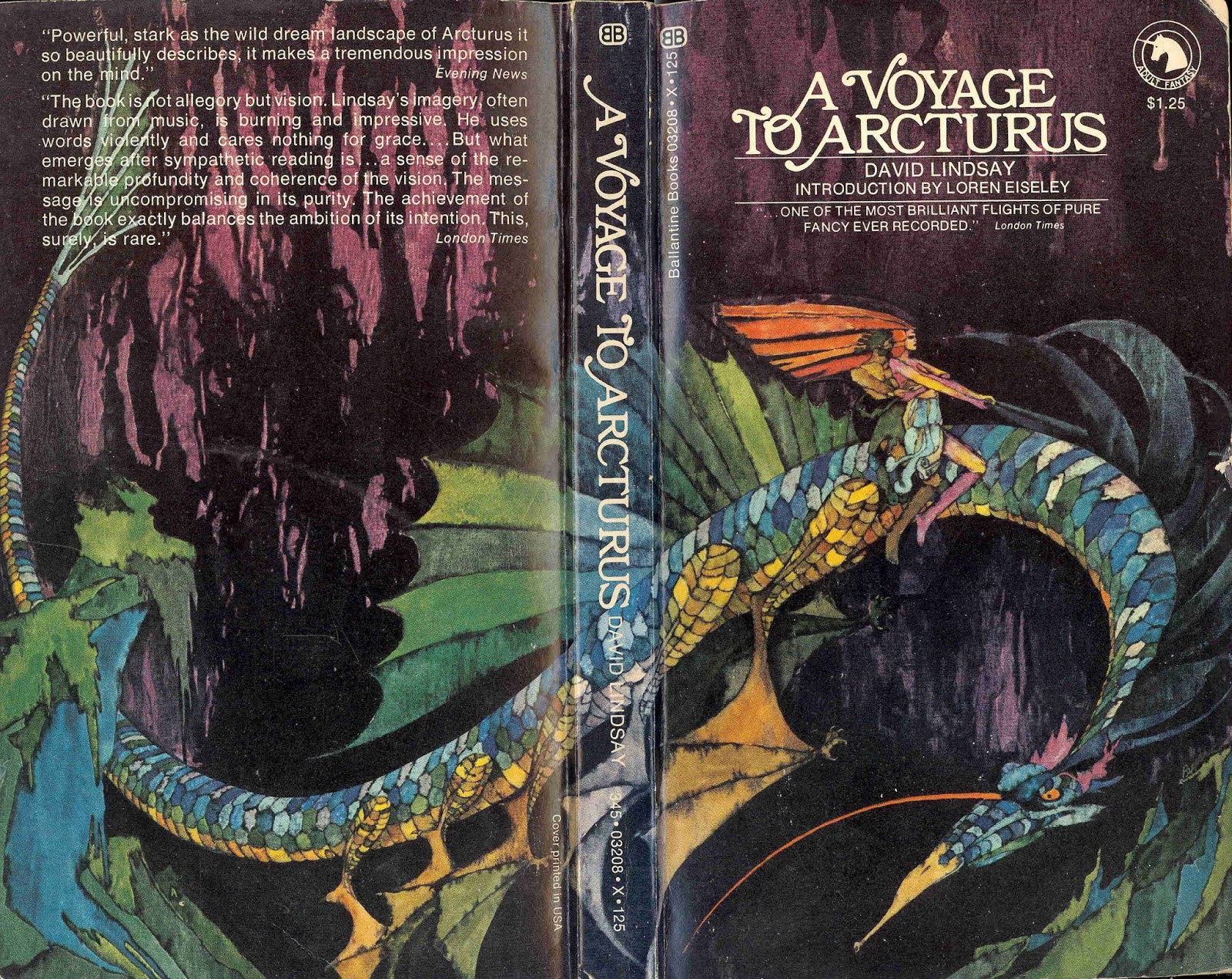
13. David Lindsay, A Voyage to Arcturus
14. Peter S. Beagle, The Last Unicorn
15. J.R.R. Tolkien. Smith of Wootton Major & Farmer Giles of Ham
16. E.R. Eddison, The Mezentian Gate [published April 1969]

The J.R.R. Tolkien books (nos. 1-5, 9 and 15) were never published under the imprint of the unicorn’s head logo, but some of the others were. 

Seventh Printing: September 1973
Of the E.R. Eddison books (nos. 6-8, and 16), the U.S. “Seventh Printing (September 1973) of The Worm Ouroboros is the only printing of any of the titles with the unicorn’s head logo.  The first U.S. printing of The Mezentian Gate, however, is marked “A Ballantine Adult Fantasy” in small print running up the spine on the upper cover (it appeared in April 1969, the month before the series proper started).  All four Eddison titles were advertised and sold in their Pan/Ballantine editions as part of the Pan/Ballantine Adult Fantasy series, though they did not have the unicorn’s head logo.  

Fourth Printing: September 1973
Mervyn Peake’s books (nos. 10-12) have the unicorn’s head logo only on two U.S. printings of each of the three books:  the “Fourth Printing: September, 1973” and the “Fifth Printing: January, 1974”.  The Peake titles were not published in the Pan/Ballantine Adult Fantasy series, because the U.K. rights were held by another publisher, Penguin Books, who published editions of all three books in 1968, 1969 and 1970, respectively. The Penguin editions were reprinted a number of times over the next several years.

Second Printing: April 1973
Two U.S. printings of David Lindsay’s A Voyage to Arcturus have the unicorn’s head logo on the cover, the “Second Printing: April, 1973 (SBN 345-03208-X) and the “Third U.S. Printing: September, 1973” (SBN 345-23208-9).  The Pan/Ballantine edition of March 1972 (SBN 345-09708-4) has the unicorn’s head logo on the front cover; the second U.K. printing from 1974 (330-24057-9) has not been seen. 

Fourth Printing: October 1972
As for Peter S. Beagle’s The Last Unicorn, the unicorn’s head logo appeared on the “Fourth Printing: October, 1972”, probably on the “Fifth Printing: February 1973” [not seen], and definitely on the “Sixth Printing: September, 1973” and “Seventh Printing: February, 1974.”  Also, the phrase “A Ballantine Adult Fantasy” appears in small print running up the spine on the upper cover, on the first printing (February 1969) through the third printing (November 1970).

First Printing: February 1969
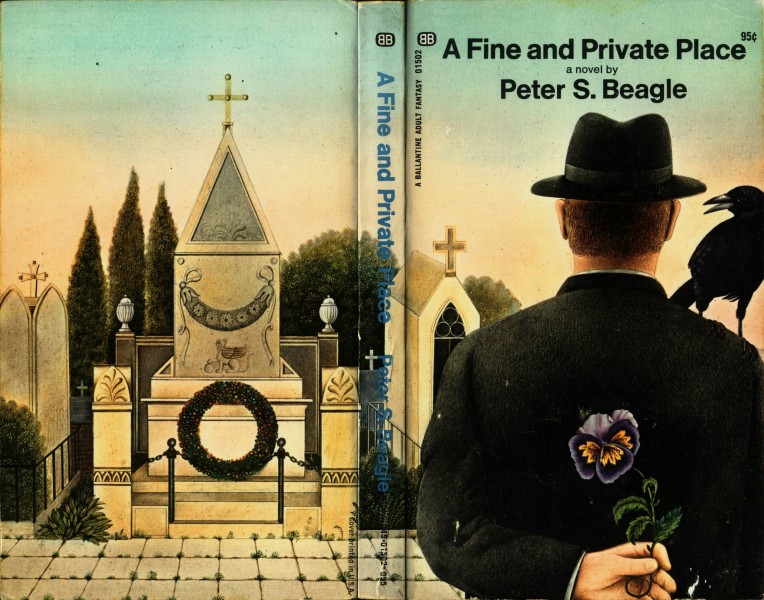
The Ballantine edition of Peter S. Beagle’s novel A Fine and Private Place also preceded the series proper. It came out in February 1969, but that the author was Beagle and that the cover art is by Gervasio Gallardo make it of interest to fans of the series. Also, as with The Last Unicorn and Eddison’s Mezentian Gate, the words “A Ballantine Adult Fantasy” appear in small print running up the spine on the upper cover.

First Printing: March 1969
Carter’s list excluded his own Tolkien: A Look Behind “The Lord of the Rings,” “First Printing: March, 1969,” which came out just before the series started. It is not usually considered to be part of the series, but it is probably of interest to most fans of the series.


Next come the various titles published by Ballantine while the series proper was ongoing (May 1969 through April 1974) that have some elements in common with the Ballantine  Adult Fantasy series, but which were never considered as officially part of the series.

First Printing: February 1971
H.P. Lovecraft. Fungi from Yuggoth and Other Poems. “First Printing: February, 1971”
This is a retitling of Lovecraft’s Collected Poems (1963), as edited by August Derleth and published by Arkham House.  The Ballantine Adult Fantasy series published other Lovecraft title, with cover art (as here) by Gervasio Gallardo.

Second Printing: February 1971
H.P. Lovecraft and August Derleth. The Survivor and Others. “Second Printing: February 1971”  This title was first published by Arkham House in 1957, and Ballantine published a first printing in mass market paperback in August 1962. For this Second Printing, a new cover was commissioned from Gervasio Gallardo. That these stories are bylined as “by H.P. Lovecraft and August Derleth” is a fraud.  They were entirely written by Derleth, who claimed them to be “posthumous collaborations” based on notes by Lovecraft, but these notes were (when discernable) minor idea fragments that barely resemble the stories Derleth wrote.

Fourth Printing: November 1971
Sometime, Never  (“Fourth Printing: November, 1971”) was originally published by Ballantine in June 1957.  It consists of three tales of “science Fantasy” by William Golding, John Wyndham, and Mervyn Peake. It was reprinted in September 1957, November 1962, and in November 1971 when it was given a new cover by Gervasio Gallardo.  The classic Peake story, “Boy in Darkness,” and the Gervasio Gallardo cover make it of special interest to fans of the series.

First Printing: November 1971
Isidore Haiblum. The Tsaddik of the Seven Wonders. “First Printing:  December, 1971”. This title is occasionally erroneously included in lists of the Ballantine Adult Fantasy series, but it had only one printing, and it never had the unicorn’s head logo on it. It is called by the publisher on the cover a Science Fantasy Novel.  The cover art is by David McCall Johnston, who did other covers in the Ballantine Adult Fantasy series proper.

First Printing: February 1972
Lin Carter. Lovecraft: A Look Behind the “Cthulhu Mythos.” “First Printing: February, 1972”  Of Carter’s three works of nonfiction published by Ballantine, his Tolkien book preceded the Adult Fantasy series proper, and his Imaginary Worlds book was included as part of the series. Why his book on Lovecraft was not included in the series is unknown, but beside Carter’s authorship, and the subject, the cover art is by Gervasio Gallardo, and these three points make it of interest to fans of the series.


Finally, the last of the outliers come from June to November 1974, and comprise two books published after retirement of the unicorn's head logo.  These were originally intended for the series before it was cancelled. The first has a Carter introduction and the second completes a set of four begun during the series proper.

First Printing: June 1974
H. Warner Munn. Merlin's Ring. “First Printing: June, 1974” Munn’s book was clearly intended for the series, as it has the usual Lin Carter introduction proclaiming it to be in the series, and the wraparound cover art is by Gervasio Gallardo. It is among Gallardo’s very best.  There remains a small white circle on the front cover, here filled with the words “First Time in Print” but which was likely intended to house the usual unicorn’s head logo. A volume of associational interest, Merlin’s Godson by H. Warner Munn, came out as a “Ballantine Fantasy” with a gryphon logo on the cover in September 1976. It contains two prequel novellas, “King of the World’s Edge” and “The Ship from Atlantis,” originally published in 1939 and 1967 respectively.

First Printing: November 1974
Evangeline Walton. Prince of Annwn. “First Printing: November, 1974” This is the final volume of Walton’s reworkings of the four branches of the Mabinogion. The first three were published as part of the Ballantine Adult Fantasy series proper, and doubtless the fourth volume would have been too, if the series hadn’t ended some six months earlier.  And instead of an introduction by Lin Carter, Prince of Annwn has a puff piece from an article by Patrick Merla published in a November 1972 issue of The Saturday Review, that was also used to replace Carter’s introductions in the other three volumes as they had been reprinted.  The cover art is by David McCall Johnston, who also did the cover art for the second and third volumes of Walton’s series.

First Printing: July 1975
Also of interest to readers and collectors of the series is the one-volume edition of William Morris’s The Well at the World’s End which was published in July 1975 (345244826  $2.95), and reprinted in May 1977 (now labelled a “Ballantine Fantasy Classic,” 0345272390  $2.95), which uses two panels of Gervasio Gallardo’s art from covers of the two volume edition.

Any one care to suggest other possibilities?  Please do so in the comments below.

Update (8/26/18):  Per the second comment below, I add here the cover of Tales of a Dalai Lama by Pierre Delattre, published by Ballantine in January 1973 (345030486 $1.25), cover art by Philippe Gravesz.
First Printing: January 1973
Update (9/29/18): Here's another outlier of interest. For the sixth printing (June 1969), the seventh (January 1971), and the eighth (July 1971), Ballantine used a Bob Pepper cover on the classic Ray Bradbury collection The October Country (first published in mass market paperback by Ballantine in April 1956):

Update (2/2/2026). Another Bob Pepper cover from the July 1971 printing of Fahrenheit 451. 


Thursday, May 10, 2018

E.R. Eddison in the Ballantine and Pan/Ballantine Editions


[Updated 8/4/18]  The history of Ballantine Books publishing the works of E.R. Eddison (1882-1945) is rather complicated, especially as one delves into the Pan/Ballantine editions and Canadian printings.  It involves only four books: The Worm Ouroboros (originally published in 1922), followed by the three volumes of Zimiamvia, Mistress of Mistresses (1935), A Fish Dinner in Memison (1941), and The Mezentian Gate (1958). The Ballantine Books editions of Eddison’s four novels came out in the U.S. between 1967 and 1969. Interestingly, the first edition of A Fish Dinner in Memison had been published only in the U.S., so the Pan/Ballantine edition of 1972 is the first edition of the book published in the U.K. Conversely, The Mezentian Gate, originally published only in the U.K., had its first American edition in the 1969 Ballantine paperback.

Does one consider any of the Eddison books as part of the Ballantine Adult Fantasy Series? That depends, for when the Ballantine Adult Fantasy series began officially in the U.S. in May 1969, all four Eddison volumes had already been published. Yet for The Mezentian Gate, which was published in April 1969, one month before the official start of the series, the phrase “A Ballantine Adult Fantasy” runs up the spine (in small type) near the top of the front cover, and there is an advertisement on the final page of the book for “Great Masterpieces of Adult Fantasy” which includes four of the titles soon to be published as part of the series proper.  And all four of the Eddison titles are definitely part of the U.K. Pan /Ballantine Adult Fantasyseries. 

Yet nearly all of these printings of Eddison do not have the unicorn’s head logo on the cover. The one exception to this is the “Seventh U.S. Printing: September, 1973” of The Worm Ouroboros (345-22001-3  $1.25), which has the unicorn’s head logo on the front cover. So whether one counts the Eddisons as part of the series really depends upon how you define the series itself.

7th printing
The cover art for three of the four books was done by Barbara Remington, who did the similarly psychedelic covers for the first Ballantine editions of Tolkien’s The Hobbit and the three volumes of The Lord of the Rings. She was unavailable to do The Mezentian Gate, so another artist, William Benson, was hired to do the cover in a style like Remington’s. Beginning in 1977, the original Ballantine covers were replaced with new covers by Murray Tinkleman.

It is sad to note the decreasing number of printings of the successive books by Eddison.  While The Worm Ouroboros achieved twelve U.S. printings between 1967 and 1981, Mistress of Mistresses saw four, A Fish Dinner in Memison four or five, and The Mezentian Gate only two.

If any reader of this blog has any of the below printings of The Worm Ouroboros marked “not seen”  and can supply scans of the covers, title and copyright pages, I’ll be grateful. Contact me at nodens100 at gmail dot com.

Readers of Eddison will be interested to know that the omnibus Zimiamvia (Dell, 1992), containing Mistress of Mistresses, A Fish Dinner in Memison, and The Mezentian Gate, published for the first time some additional parts Eddison wrote of The Mezentian Gate. This includes a large section of chapter 30, and other passages in chapters 8, 12, and 31-33.

My thanks go to Trevor Livelton, Bill Lloyd, and Jon Preece for assistance with this post.


The Ballantine Printings of E.R. Eddison

The Worm Ouroboros
New York: Ballantine Books, [April] 1967 [cover art by Barbara Remington]
            “First Printing: April, 1967” on copyright page
Second Printing: April 1967 [3rd & later printings say May] [not seen?]
“Third American Printing: October, 1967” [printings listed as “First American 
             Printing … Third American Printing”]
“Fourth American Printing: May, 1968”
“Fifth Printing: August, 1970”
“Sixth Printing: March, 1972” [printed in England; 7th says January 1972] 
            [NB: This copy has U.S. price of $1.25 printed on the cover, and no 
            other prices]
“Seventh U.S. Printing: September, 1973” [Unicorn Mast on front cover] 
            [Beginning with the 7th printing, the list of printings on the copyright 
            page has been reset so that each line reads “First U.S. Printing” / 
           “Second U.S. Printing” / etc.]
Eighth U.S. Printing: October, 1974
“Ninth U.S. Printing: February, 1976”
“Tenth U.S. Printing: November 1977” [cover art, by Murray Tinkelman]
“Eleventh U.S. Printing: June 1978”
“Twelfth U.S. Printing: December 1981” [cover border color changed from 
            green to light orange]
 
First Canadian Printing: September 1967
Second Canadian Printing: November 1967

London: Pan/Ballantine, [June 1971]  [0-345-02001-4 “Printed in Canada”
           Prices on rear cover: U.K. 40p, plus Australia, New Zealand and 
           South Africa.]

“Reprinted 1972” [0-345-09740-8  “Printed in England”  Prices on rear cover: 
           U.K. 50p, plus Australia, New Zealand, and South Africa.]
“3rd printing 1973” [0-330-23841-8 “Printed in Great Britain by Richard 
            Clay” Prices on rear cover: U.K. 50p, plus Australia and New Zealand. 
            “Not for sale in Canada.”
“4th printing 1975” [0-330-23841-8  Prices on rear cover: U.K. 75p, plus 
            Australia and New Zealand. “Not for sale in Canada.”


1st printing

10th and 12th printings
Mistress of Mistresses: A Vision of Zimiamvia
New York: Ballantine Books, [August] 1967 [cover art by Barbara Remington]
            “First Printing: August, 1967” on copyright page
Second Printing: September 1967
Third Printing: May 1968
“Fourth Printing: January 1978” [cover art by Murray Tinkelman]

First Canadian Printing: November 1967

[U.K. edition:]  New York: [Pan/]Ballantine, [June, 1971] [have] “Printed in 
            Canada” on copyright page.  “Cover printed in Canada” on rear cover.  
            Prices and ISBN on reader cover: 345-02006-5 U.K. (8/-) 40p, plus 
            Australia, New Zealand, South Africa. The copyright page lists the 
Third Printing: May 1968 as the latest printing, but this must be an 
unacknowledged Canadian printing made for distribution in the U.K. 
“Pan” as publisher and the 1971 date of first U.K. publication do not 
appear anywhere on the book. 

1st printing
4th printing

A Fish Dinner in Memison
New York: Ballantine Books, [February 1968] [cover illustration by Barbara 
             Remington.] “First Printing: February, 1968” on copyright page
Second Printing: September 1970
“Third Printing: April 1978” [cover art by Murray Tinkelman]
Fourth Printing: May 1978 [mentioned in the “Special Printing” below]
First Special Printing: July 1978  [This is apparently a printing for the U.K. 
            market, with a price of £1 on rear cover. Also, this has a different 
            ISBN 0345278607]
[Fifth?]: July 1979  [not seen]

London: Pan/Ballantine, [July] 1972 [345-097410-6 “Printed in Great Britain 
            by Richard Clay” Prices on rear cover: U.K. 40p, plus Australia and 
            New Zealand. “Not for sale in Canada.”]

1st printing
3rd printing

The Mezentian Gate
New York: Ballantine Books, [April 1969] [uncredited cover illustration by
William Benson, in the style of Barbara Remington]
“First American Printing: April, 1969” on copyright page
“Second Printing: May 1978” [cover art by Murray Tinkelman]

London: Pan/Ballantine, [July] 1972 [345-09742-4 “Printed in Great Britain by
Richard Clay” Prices on rear cover: U.K. 40p, plus Australia and New 
Zealand. “Not for sale in Canada.”]

1st printing


2nd printing